
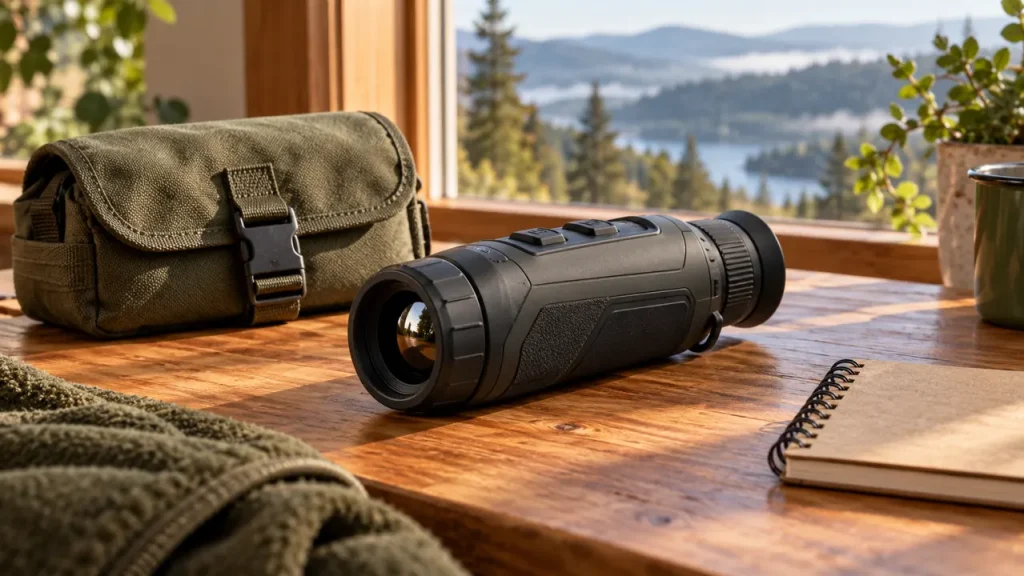
This 2026 refresh compares four existing thermal monocular models, with different strengths and price points. Here, budget means an intended spending limit of up to $1,000, not a verified current price for every model. The ATN OTS 4T is a higher-cost reference; check current prices, condition, and warranty before buying. This guide will explore the best thermal monoculars under budget in 2026, highlighting key features, pros and cons, and what to look for when purchasing a budget-friendly thermal monocular.
Quick verdict: which option fits your budget?
For basic short-range heat detection, consider the FLIR Scout TK only if remaining stock or a used unit is priced attractively and has an acceptable battery and return policy. For more sensor detail and recording, compare the Pulsar Axion XM30F against current models at the same price. If you are considering a used unit, follow the used thermal monocular inspection checklist before committing to the offer.
The Leupold LTO-Tracker 2 is a basic tracking option with limited sensor detail. The ATN OTS 4T is a heavier, higher-cost reference, not a verified sub-$1,000 recommendation.
Budget thermal monocular comparison
| Model | Resolution | Detection Range | Battery Life | Weight | Field of View |
|---|---|---|---|---|---|
| FLIR Scout TK | 160×120 | Over 90m (100 yd), per FLIR | Over 5 hours, manufacturer rating | 170g | 20° x 16° |
| Pulsar Axion XM30F | 320×240 | 1,300m, deer-sized target detection | Up to 7 hours at 22°C | 310g with battery | 7.8° x 5.9° |
| Leupold LTO-Tracker 2 | 206×156 sensor | 600 yd general; 250 yd typical deer | Up to 10 hours | Confirm supplied unit | 16.9° at 1.5x |
| ATN OTS 4T | 384×288 or 640×480; check the selected model | Depends on lens and variant | Approximately 16 hours; varies | Check the selected model; 850g for 384 1.25-5x | Depends on lens and variant |
1. FLIR Scout TK
The Scout TK makes the most sense for someone who wants a small, straightforward way to check for nearby heat sources. Its 160×120 sensor is suited to basic scanning around a yard or campsite, rather than identifying an animal across a large field. Before buying, check battery condition, warranty coverage, and the seller’s return policy.

Basic short-range scanning
FLIR Scout TK
- 160×120 thermal sensor
- 170g including lens
- 20° x 16° field of view
A compact choice for nearby heat detection.
View on AmazonKey Features:
- Resolution: 160×120
- Detection Range: Over 90 meters (100 yards), per FLIR; detection, not identification
- Battery Life: 5 hours
- Field of View: 20° x 16°
- Weight: 170g (6 oz, including lens)
Pros
- Extremely lightweight and portable.
- Simple to use, making it perfect for first-time users.
- Basic short-range heat detection; limited fine detail.
- Value depends on current stock price and condition.
Cons
- Limited detection range compared to more expensive models.
- Lower resolution may not be suitable for high-detail observation.
2. Pulsar Axion XM30F
If the Scout TK feels too limited, the Axion XM30F offers a step up in sensor detail, along with recording and a replaceable battery. Its narrower field of view suits looking into a specific area, but takes more scanning to cover the ground nearby. Pulsar’s 1,300m figure is for detecting a deer-sized target, not identifying one. Compare its price, included battery, and warranty with other models offering similar sensor detail.

More detail and recording
Pulsar Axion XM30F
- 320×240 thermal sensor
- Up to 7 hours at 22°C
- 310g with battery
Compare the included battery, warranty, and overall price.
View on AmazonKey Features:
- Resolution: 320×240
- Detection Range: 1,300 meters (4,265 feet), for deer-sized target detection
- Battery Life: Up to 7 hours
- Field of View: 7.8° x 5.9°
- Weight: 310g with battery
Pros
- 320×240 thermal sensor with recording and Wi-Fi.
- Long quoted detection range; identification requires a closer view.
- Lightweight and portable, ideal for outdoor activities.
- Replaceable APS 3 battery for extended outings.
Cons
- Check price, battery condition, warranty, and availability.
3. Leupold LTO-Tracker 2
The LTO-Tracker 2 is better understood as a tool for locating heat than for studying fine detail. Beacon Mode helps warmer areas stand out, while the 206×156 sensor sets a clear limit on how much you can see. Digital zoom makes the image larger without creating extra detail. It may be worth considering for basic tracking when the price and condition suit your needs.

Basic heat tracking
Leupold LTO-Tracker 2
- 206×156 thermal sensor
- Beacon Mode
- Digital zoom up to 7x
Key Features:
- Resolution: 206×156 thermal sensor; 240×204 display
- Detection Range: 600 yards (approximately 549m) general detection; typical deer detection 250 yards (approximately 229m)
- Battery Life: Up to 10 hours continuous use, per Leupold
- Field of View: 16.9° at 1.5x
- Weight: Confirm battery-inclusive weight on the supplied model
Pros
- Good balance of size and performance.
- Beacon Mode helps emphasize warmer heat sources.
- Durable and water-resistant.
Cons
- Digital zoom up to 7x enlarges the image without adding sensor detail.
- Low sensor resolution limits identification at distance.
4. ATN OTS 4T
The OTS 4T belongs at the higher-cost end of this comparison. Its recording features and choice of sensor and lens variants may appeal if you need more than a simple pocket viewer, but it is substantially heavier than the smaller options here. Choose the exact variant before comparing specifications or prices: the family does not share one detection range or field of view. Compare the exact lens and sensor configuration before ordering.

Higher-cost comparison
ATN OTS 4T
- 384×288 or 640×480 sensor options
- Approximately 16-hour runtime; varies
- Weight and viewing angle depend on the selected model
Key Features:
- Resolution: 384×288 or 640×480; confirm the variant
- Detection Range: Depends on lens and variant
- Battery Life: Approximately 16 hours per the OTS 4T manual; varies with conditions
- Field of View: Depends on lens and variant
- Weight: Check the selected model; 850g for the 384 1.25-5x
Pros
- 384×288 and 640×480 sensor options in the OTS 4T family.
- Lens options provide different detection distances.
- Recording features for documenting observations.
- Smartphone app compatibility for additional features.
Cons
- Heavier and generally more expensive than entry-level handheld models.
- Battery life may vary based on settings.
How to choose for your viewing distance and budget
For a yard, campsite, or nearby wildlife: prioritize a useful field of view, simple controls, and a comfortable eyepiece. The Scout TK is a basic heat-detection option; its low sensor resolution limits fine detail. The viewing-distance guide explains how the distance and size of a subject affect this choice.
For scanning larger areas: the XM30F offers a higher-resolution sensor than the Scout TK, but its narrower field of view covers less ground at once. A long advertised detection distance does not establish the distance at which you can identify an animal.
For a strict spending limit: compare the complete purchase cost, including batteries and warranty. Each model should offer a clear price or feature advantage over similarly priced alternatives. Do not stretch a limited budget for the OTS 4T solely because it appears in this comparison. Our guide to sensor, lens, and total cost helps separate useful capability from features you may not need.
Specifications that matter before you buy
Use these factors to compare a budget thermal monocular against your actual viewing needs:
- Resolution and Image Quality: Resolution is critical for clear and detailed images. While budget thermal monoculars might not have the high resolutions of their more expensive counterparts, look for options with at least a 160×120 or 320×240 resolution for decent quality.
- Detection Range: Depending on your intended use, detection range varies. For hunting or outdoor activities, you might need a monocular with a longer detection range. Quoted detection distances depend on target size and conditions. Detecting a heat source does not mean recognizing a species or positively identifying it.
- Battery Life: Battery life is an important factor, especially for extended outdoor trips. Runtime depends on temperature, battery condition, recording, and wireless settings; compare manufacturer test conditions.
- Field of View (FOV): A wider field of view can help you track moving objects. A narrower FOV might be limiting, especially for activities like wildlife observation.
- Size and Weight: If you plan to carry the monocular for long periods, look for lightweight, compact models that are easy to handle and store.
- Thermal Sensor Type: The type of thermal sensor used in the monocular impacts its performance. Many budget models utilize uncooled infrared sensors, which are sufficient for most casual and recreational uses.
What thermal imaging helps you see
Thermal monoculars detect heat signatures without ambient light, which can help locate people, animals, or other warmer objects in darkness. They do not provide the same detail or depth cues as normal vision. Dense fog, rain, vegetation, and low thermal contrast can reduce useful visibility; stop to scan rather than relying on thermal imaging alone while moving.
Specification sources and buying limitations
This comparison uses manufacturer specifications and documentation; the figures above are not measured field-test results. Manufacturer detection ratings use different target sizes and conditions, so they are not a controlled side-by-side performance test. Runtime and image quality in use can differ from published figures.
Sources: FLIR Scout TK specifications; Pulsar XM30F manual; Leupold LTO-Tracker 2 guide; ATN OTS 4T manual. Confirm the supplied unit’s model number, condition, warranty, and seller listing before purchase.
YOUR NEXT STEP
Which budget thermal monocular should you choose?
Start with the distance you usually scan and the detail you need. The most useful purchase is the one that meets those needs at a price you are comfortable paying.
- For simple, nearby scanning: compare the FLIR Scout TK.
- For more sensor detail and recording: consider the Pulsar Axion XM30F.
- For basic heat tracking: look at the Leupold LTO-Tracker 2.
- For more features and a larger budget: compare the ATN OTS 4T configurations.
Frequently Asked Questions
1. How much should I spend on a budget thermal monocular?
Set a firm spending limit and compare current offers within it. This guide uses up to $1,000 as a planning budget, not a verified price for every listed model. Older stock, used units, and higher-cost OTS 4T variants may fall outside that limit. Include batteries, warranty, and returns in the comparison.
2. What is the detection range of budget thermal monoculars?
Detection depends on target size, lens, sensor, weather, and thermal contrast. FLIR describes heat sources over 90m away for the Scout TK; Pulsar quotes 1,300 meters for detecting a deer-sized target with the XM30F. These are not guaranteed recognition or identification distances.
3. Can thermal monoculars under budget work in complete darkness?
Yes, thermal monoculars excel in complete darkness because they detect heat signatures, not visible light. Unlike night vision devices, thermal monoculars work without ambient light and may reveal heat sources through some smoke or haze. Dense fog and rain can reduce contrast and detection distance. This makes them highly useful for nighttime activities like hunting, surveillance, and search and rescue.
4. Are budget thermal monoculars waterproof?
Many budget thermal monoculars are built to be weather-resistant or waterproof, which is an important feature for outdoor use. Pulsar specifies IPX7 for the XM30F; ATN describes the OTS 4T as weather-resistant. These descriptions do not establish identical protection. However, always check the IP rating (Ingress Protection) before purchasing to ensure that the device meets your specific needs in wet conditions.