
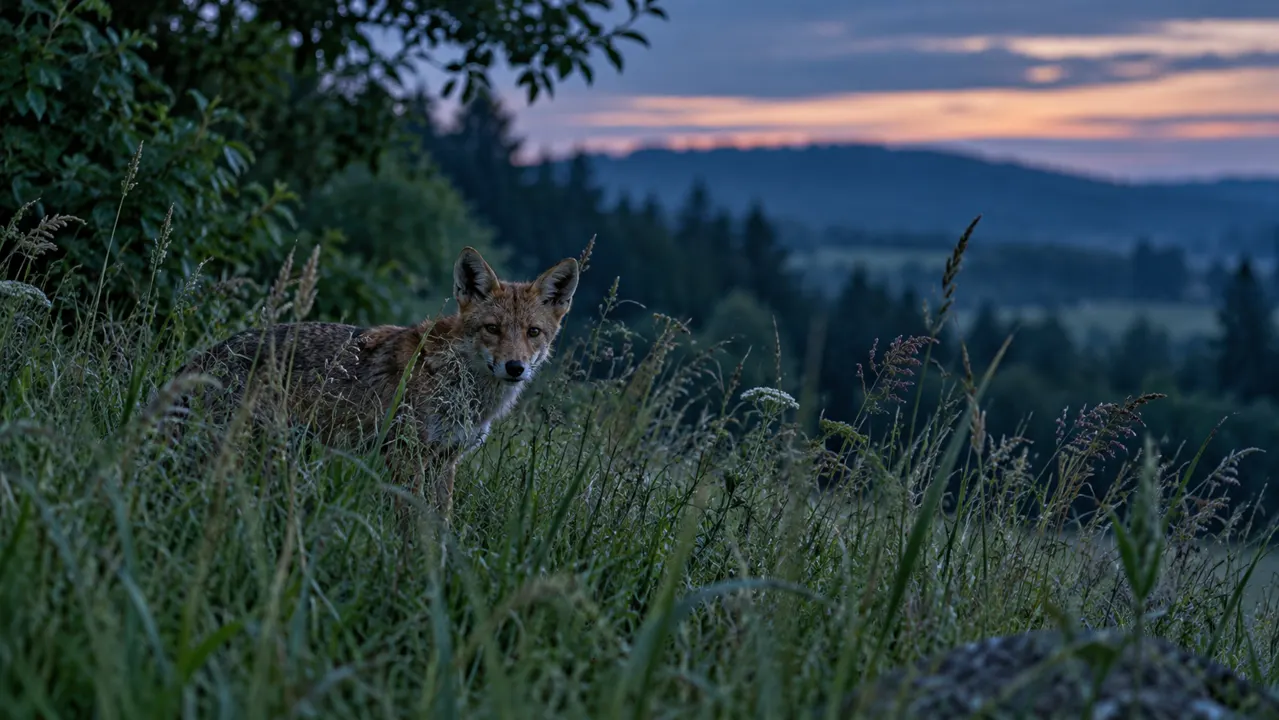
A warm shape appears near the edge of a field. You can see that something is there, but the outline is small and part of it disappears behind grass. Has the thermal monocular identified an animal, or has it simply drawn your attention to a heat source? That distinction is the starting point for interpreting thermal imagery responsibly and choosing equipment with realistic expectations.
Detection, recognition, and identification describe different levels of information. They are useful terms, but they are not interchangeable promises. This article explains how to assess the evidence in the image, record uncertainty, and read range claims. It supports our thermal monocular guide for coyote hunting without assigning any product a universal species-identification distance.
Detection answers the first, narrowest question
Detection means noticing a possible subject against its surroundings. You might see a brighter patch, a darker outline, or movement that deserves another look. At this stage, the useful conclusion can be as limited as “there is a distinct feature in this location.” The image may not yet establish that it is alive.
Think of a heat source beside a fence. A small bright area could be an exposed part of an animal, a surface retaining warmth, or another object with a different apparent thermal signature. Its visibility is meaningful, but assigning a familiar label immediately adds information that the image may not contain.
Detection remains valuable even when it does not resolve identity. It directs attention to an area worth examining. The mistake is treating that first alert as the answer to every later question. A successful detection can coexist with an unresolved identification.
Recognition provides a broader category
Recognition involves enough information to distinguish a general kind of subject. A developing outline might indicate an animal rather than a fixed object. Several frames may show legs moving beneath a body. That supports a broader interpretation while leaving the species uncertain.
Context helps, but it can also bias you. If you expect coyotes at one location, an ambiguous animal shape may appear to confirm that expectation. Make yourself describe the visible features before naming the subject. “Four-legged animal moving along the hedge” is a more honest observation than a confident species label supported only by location.
Movement is additional evidence, not a shortcut to certainty. Watch enough of the sequence to distinguish actual movement from your own panning, vegetation moving in front of the subject, or changes introduced by image processing. If the evidence remains incomplete, retain the broader category in your notes.
Identification requires the details relevant to the decision
Identification is the stage at which the available evidence supports a specific conclusion about the subject. In wildlife observation, that might mean establishing the species from a sufficiently clear combination of outline, proportions, movement, and other corroborating information. It does not mean that every individual animal can be distinguished from another of the same species.
The word also depends on context. A technical range model can define identification for a particular target set and probability, whereas an observer may use the same word informally. Read the definition behind a rating before applying it to your own task. A modeled result for a human-sized target is not automatically a field guarantee for a smaller animal.
FLIR’s discussion of detection, recognition, and identification ranges explains that assumptions, conditions, and probability are part of the result. That is why a bare distance, separated from its target and test basis, gives an incomplete account of capability.
Why target size changes the interpretation
A nearby subject occupies more of the captured image than the same subject farther away. As it becomes smaller in the scene, fewer captured details describe its outline. You may continue to notice a thermal difference after the features needed for recognition have disappeared.
Orientation matters too. An animal viewed from the side presents a different outline from one facing the observer. Grass may hide its legs, or the head may overlap the body. A recognizable side view in a demonstration does not establish equal confidence from every angle.
This explains why comparing maximum distances for different target descriptions is misleading. Preserve the manufacturer’s wording about target size when you record a specification. If your usual subject is smaller or partly concealed, treat that difference as an unanswered question that needs relevant evidence.
Digital enlargement does not settle ambiguity
Zoom can make captured information easier to inspect. It does not create the missing thermal samples needed to distinguish features that were not resolved in the original image. A larger blur remains limited evidence, however dramatic it looks on a display.
Image processing can make outlines more visible or easier to follow, but a pleasing picture is not proof of a correct interpretation. Compare the subject before and after changing a setting. Ask which actual feature has become clear, rather than whether the whole image looks sharper.
For a familiar analogy, enlarging a tiny section of a photograph can make it easier to view without making a hidden character readable. Use magnification to examine evidence, not to replace it. Our magnification guide covers the equipment distinction in more detail.
Background and obstructions can remove the decisive features
A subject may stand out clearly against one background and be difficult to interpret against another. Warm surfaces, uneven vegetation, and overlapping objects can complicate the outline. The relevant question is whether the features supporting your conclusion remain distinguishable in that scene.
Ordinary thermal monoculars do not reveal an unobstructed animal through a solid wall or dense vegetation. Exposed parts may be visible through gaps, while other parts remain hidden. FLIR’s explanation of thermal imaging through common materials is a useful check against claims that thermal viewing simply removes obstacles.
Do not mentally complete a hidden outline just because the visible portion resembles a familiar animal. Reassess when the subject changes position or another observation becomes available. An apparent head, tail, or leg that never becomes independently clear should remain an interpretation, not a recorded fact.
Weather changes the amount of usable information
Rain and fog can affect thermal visibility; the effect is not one fixed reduction that applies to every device and scene. FLIR describes the role of atmospheric conditions in its fog and rain explanation. A rating obtained in favorable conditions should not be treated as a guaranteed result during poor visibility.
An animal that is obvious on one evening can be less distinct on another without the monocular developing a fault. Record the conditions before deciding whether a disappointing image proves a product limitation. Equally, do not excuse every unclear view as weather when focus or an obstructed lens could be responsible.
Check the straightforward variables first: your eyepiece adjustment, objective focus where applicable, lens condition, and selected image settings. Then decide whether the remaining information supports your intended conclusion. Changing several settings at once makes it harder to understand what helped.
Use a deliberate observation sequence
Begin by locating the feature in relation to something you can recognize in the landscape. Hold the view steady and inspect the original outline. Note which parts are visible, what is obscured, and whether the subject actually moves. Only then use enlargement if it helps inspect a particular feature.
Next, challenge your first interpretation. Could the image fit a different object or animal category? What visible evidence rules that alternative out? You do not need to produce a long list of possibilities; the purpose is to avoid turning expectation into certainty without noticing.
Finally, decide the appropriate confidence level. You might record “heat source,” “unidentified animal,” or a species supported by sufficient detail. If an observation would inform a consequential action, obtain the necessary independent confirmation. Thermal brightness alone establishes neither identity nor what lies beyond a subject.
Make recordings useful without overstating them
Keep the original recording rather than only a cropped screenshot. A sequence can retain the approach, changing angle, and surrounding scene that help another person assess your interpretation. Store your notes separately so a label added afterward is not confused with something the device established.
Record approximate location, time, conditions, model, and zoom setting when known. If the distance was estimated rather than measured, say so. If someone else supplied the species label, distinguish their report from your own observation. These small habits make wildlife records more useful without requiring elaborate software.
Reviewing footage later can reveal a feature you missed in the moment. It can also leave the answer unresolved. Avoid assuming that a bigger monitor, frame extraction, or a colorful palette makes an uncertain recording conclusive. The original captured information remains the limit.
What to ask when a seller advertises identification range
Ask what target was used, how identification was defined, and which conditions applied. Find out whether the quoted result comes from a calculation, a manufacturer specification, or a documented demonstration. Those can all be informative, but they are different types of evidence.
Request the exact model and configuration shown in any sample. A family name can cover several lenses and detectors. Confirm whether the footage is direct device output, a camera filming the eyepiece, or an edited promotional sequence. Missing information should reduce confidence in the comparison rather than encourage a favorable assumption.
Use our guide to choosing for viewing distance to connect those answers to your observation area. The aim is not to find a universal number that ends all uncertainty. It is to buy equipment with evidence relevant to the questions you actually need it to answer.
Keep the conclusion as precise as the image
Good interpretation means matching the strength of your conclusion to the strength of the evidence. Detection can tell you where to look. Recognition can narrow what you are seeing. Identification requires the relevant details to support a specific answer, and sometimes those details simply are not available.
When comparing the products in our coyote thermal monocular buying guide, keep these stages separate. You can appreciate a scanner’s ability to reveal a distant heat source while remaining realistic about what that sighting establishes.