
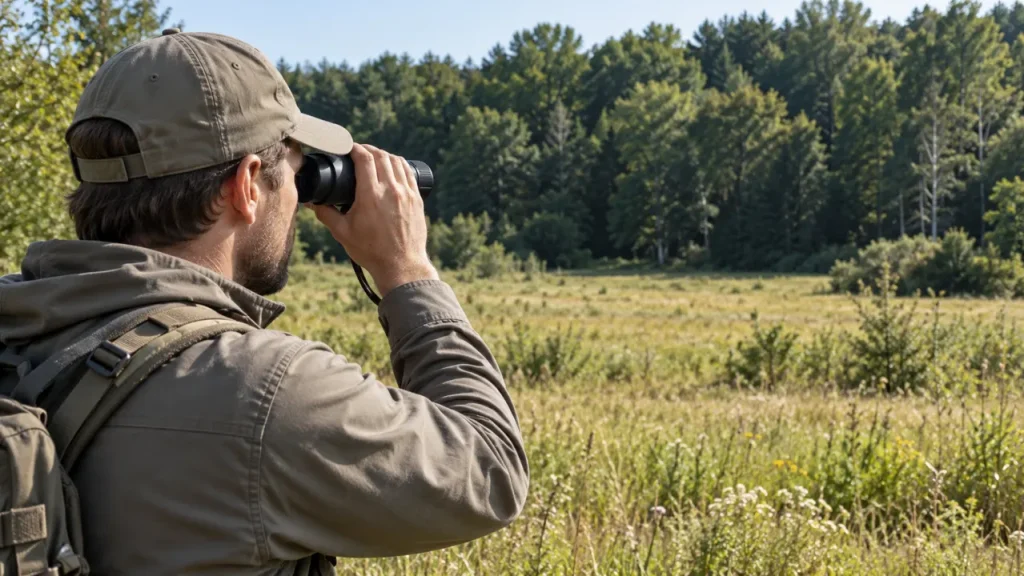
Yes, but daylight changes the scene you are interpreting.
A thermal monocular can be used in daylight because it does not depend on darkness to form an image. It detects radiation in its operating infrared band rather than needing a dark background or an external night-vision illuminator. That makes it useful for some daytime observation tasks, but it does not mean performance is identical at every hour.
Sun-warmed ground, vegetation, vehicles, and buildings can produce busy backgrounds. A subject that stands out strongly before dawn may be harder to separate from its surroundings after several hours of sunshine. The instrument still works; the contrast available in the scene has changed.
There is also an important handling distinction: normal daylight use is not permission to aim an open thermal objective at the sun. Follow the manufacturer’s warnings about intense energy sources, including sunlight and lasers, and keep the objective covered when the device is not being used.
Why sunlight does not switch thermal vision off
A thermal viewer forms an image from differences in the radiation reaching its detector. Visible daylight is not the main signal used by a conventional long-wave thermal monocular. You therefore do not need to wait for sunset before looking at a shaded field edge, a wooded area, or a suitable outdoor subject.
What sunlight does change is the temperature distribution across that scene. A dark surface in sunshine can behave differently from a neighboring shaded surface. Materials heat and cool at different rates, so the thermal picture may look unlike the familiar visible-light view.
This explains why “works by day” and “gives the same contrast by day” are different claims. A good daytime result depends on subject size, background, weather, optics, detector performance, and how carefully you interpret the image. Ambient brightness alone does not settle the question.
Solar heating can create false leads
Solar loading describes heating associated with absorbed solar energy. In an outdoor scene, it can make stones, bare ground, metal structures, roofs, and other surfaces stand out. Their appearance may draw your attention even though they are not the person or animal you are looking for.
Imagine scanning the edge of a field on a bright afternoon. A sunlit object can produce a conspicuous patch while an animal resting in nearby shade produces a subtler pattern. It would be a mistake to identify the brightest patch simply because the display makes it prominent.
Use shape, movement, location, repeated observations, and a suitable visible-light view to assess what you have found. Change your viewing angle when practical and look for context. A thermal monocular is a way to discover differences, not a device that assigns a reliable identity to every bright region.
The difficult periods around thermal crossover
Thermal contrast can become less useful when a subject and its surroundings produce similar apparent signals. Changes around morning and evening can create periods in which parts of the scene converge thermally. The timing and severity depend on material, weather, exposure, and the subjects involved; there is no universal clock time when every location becomes difficult.
Do not interpret a weak image as immediate proof that the detector has failed. Compare another part of the scene, check focus, and consider how the background has been heated. A nearby surface may still look crisp while the particular subject you want blends into its surroundings.
Equally, do not expect software to restore information the scene does not supply. Processing can help present subtle differences, but a more dramatic palette cannot guarantee useful contrast when the radiation reaching adjacent pixels is very similar.
Reflections are another daytime complication
Thermal radiation can be reflected as well as emitted. Low-emissivity or reflective surfaces may show patterns influenced by other objects around them. That makes polished metal and glass particularly easy to misread if you expect every thermal patch to represent the surface’s own temperature.
A window is not a transparent shortcut for a typical long-wave thermal monocular. You may be viewing the glass surface or reflected radiation instead of seeing the room or animal behind it. A change in your position can change a reflected pattern, which is a useful clue that you should examine the scene more carefully.
These effects are not limited to daylight, but daytime surroundings provide many opportunities for confusion. Check the visible scene where possible and avoid drawing conclusions from one isolated image without understanding the surface you are observing.
How to set up for daytime observation
Begin with a sensible base view rather than maximum digital zoom. Set the eyepiece so the display is comfortable, then focus the objective for the subject distance if the model provides that adjustment. The two controls solve different problems; adjusting one is not always a substitute for adjusting the other.
Use a palette that makes boundaries and movement easy for you to interpret. White Hot and Black Hot can be straightforward starting points, while other palettes may help separate particular signals. Avoid the assumption that a colorful image is automatically more informative.
If the image develops unevenness or the manual recommends recalibration, use the correct calibration procedure for that model. A shutter correction and an autofocus adjustment are not the same action. Read the instructions rather than repeatedly pressing controls and hoping the image improves.
What changes with weather and distance?
Humidity, rain, fog, and the atmosphere between the instrument and subject can reduce useful range and contrast. A thermal monocular may outperform a visible view in some obscured conditions, but “thermal sees through fog” is too broad to be a reliable rule. Fog type, density, operating wavelength, and the viewing task all matter.
Distance also changes how much of the detector the subject occupies. A small warm animal nearby can be easier to interpret than a larger but distant shape. Digital enlargement does not increase the number of original detector pixels covering that distant subject.
For comparison footage, look for the actual observation distance and conditions. A clear daytime clip recorded on a dry cool day does not establish the same performance on a humid afternoon. Match demonstrations to the kind of scene you expect to encounter.
Where daytime thermal viewing can be useful
Daytime thermal observation can complement normal optics when a subject has useful contrast against its background. For example, it can draw attention to an exposed warm shape that is visually difficult to notice among similarly colored surroundings. You still need enough unobstructed detail to understand what you have found.
It can also help with repeated observation of a known area. A change from the familiar pattern may prompt closer inspection, particularly when you know which surfaces normally receive sun or remain shaded. That contextual knowledge is more valuable than assuming every warm region is unusual.
Keep the application appropriate to the instrument. An outdoor observation monocular is not automatically a calibrated inspection camera, a medical screening instrument, or a substitute for specialist equipment. If accurate temperature measurement is essential, choose an instrument and procedure intended for that purpose.
A safe routine for using it in daylight
Before leaving, read the model’s warnings and check the lens cap, battery, controls, and weather limitations. Choose an observation position that lets you scan without crossing the sun with the open objective. Never use the device as a way to look at the sun.
During use, pause to inspect and interpret the scene. Keep a normal view of your surroundings and avoid walking while treating the display as a complete picture of the ground. Thermal contrast does not guarantee visibility of holes, branches, fences, or other hazards.
Afterward, replace the cap and store the instrument according to the manual. Avoid leaving it in a position where the objective faces an intense source, or where a hot vehicle interior exceeds its storage limits. Charging and operating-temperature limits can differ, so check both rather than assuming one rating covers everything.
If the daytime image suddenly looks poor
Separate an electronic problem from a difficult scene. First inspect a nearby known object, then check both focus adjustments and the manual’s correction procedure. If that object looks clear but a distant subject blends into the background, contrast or distance may be the main limitation. If everything looks uneven or blurred, check the objective for moisture or dirt and confirm that settings have not changed.
Stop using the instrument and consult support if you see a persistent problem that the documented checks do not resolve. Do not experiment by aiming it toward a hotter or brighter source to “test the sensor.” A familiar scene and the manufacturer’s troubleshooting sequence provide a more controlled starting point.
When another view is the better choice
If you need to read lettering, inspect surface color, or distinguish fine visible markings in good daylight, a conventional optical monocular may provide the more useful picture. Thermal is valuable for radiation contrast, not for reproducing the world exactly as your eyes see it.
For wildlife, combine detection with confirmation. A thermal shape can tell you where to direct attention, while binoculars or another appropriate view may help resolve details that thermal imaging does not show clearly. An uncertain sighting remains uncertain regardless of how bright it appears on the display.
The practical answer is yes: use a suitable thermal monocular by day within its operating guidance. Expect solar heating, background changes, reflections, and weather to affect interpretation, and never confuse daytime capability with permission to aim at the sun.
Related guides
For the underlying technology, read how thermal monoculars work.
To compare optical and electronic enlargement, see choosing monocular magnification.
Sources
Technical explanations were checked against Pulsar: bright sunlight guidance; FLIR: fog and rain; FLIR: emissivity and reflections. Practical examples and buying advice are explanatory, not claims of measured field testing.