
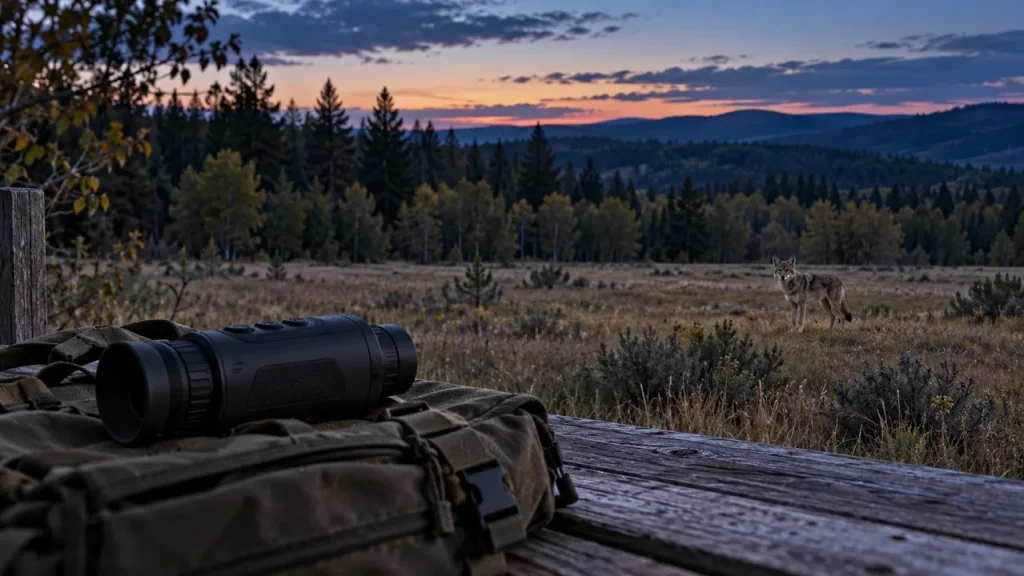
The best thermal monocular for coyote hunting should help you find heat sources quickly and leave enough detail to decide what deserves a closer look. For this 2026 comparison, the Pulsar Helion 2 XP50 Pro is the detail-first option, the Pulsar Axion XM30F favors portability, and the AGM Taipan TM15-384 offers wider coverage. The FLIR Scout TK is limited to basic nearby detection; the ATN OTS LT needs an exact-model check before comparing specifications.
These are handheld observation tools. A distant heat signature is not positive identification of a coyote, and a manufacturer’s detection rating is not an identification distance. This guide compares documented specifications and practical trade-offs rather than claiming measured field-test results.
Quick picks: choose by detail, coverage, and portability
- Detail-first option: Pulsar Helion 2 XP50 Pro.
- Pocket-friendly scanner: Pulsar Axion XM30F.
- Basic nearby heat detection: FLIR Scout TK — for short-range checks, not distant identification.
- Wider-view midrange option: AGM Taipan TM15-384.
- Simple controls and viewing: ATN OTS LT.
Thermal monocular comparison
| Model | Thermal sensor | Magnification | Field of view | Battery rating | Main reason to compare |
|---|---|---|---|---|---|
| Pulsar Helion 2 XP50 Pro | 640×480 | 2.5x; up to 20x digital-assisted | 12.4° horizontal | Up to 8h at 22°C | Detail over minimum size |
| Pulsar Axion XM30F | 320×240 | 3x; 3–12x viewing range | 7.8° x 5.9° | Up to 7h at 22°C | Portable scanning |
| FLIR Scout TK | 160×120 | Basic viewing; limited fine detail | 20° x 16° | Over 5h rated | Nearby detection only |
| AGM Taipan TM15-384 | 384×288 | Low base magnification; digital zoom | 17.5° x 13.1° | Up to 7.5h rated | Covering nearby ground |
| ATN OTS LT | 160×120 or 320×240 | Depends on selected lens | Depends on selected lens | Check exact model | Viewing-focused simplicity |
Battery figures are manufacturer ratings, not a controlled runtime comparison. Temperature, battery condition, and wireless use can change them. Field of view and base magnification often tell you more about scanning comfort than the maximum digital zoom setting.
1. Pulsar Helion 2 XP50 Pro 2.5-20 Thermal Monocular
The Helion 2 XP50 Pro is the strongest starting point in this list if image detail matters more than pocket size. Its 640×480 sensor gives you more pixels to work with than the smaller-sensor options below. That helps when you want to study a heat source rather than simply notice that something is there. The trade-off is a larger body and a purchase price that needs to make sense for how often you will use it.

Detail-first option
Pulsar Helion 2 XP50 Pro
- 640×480 thermal sensor; 50 Hz refresh rate
- 2.5x optical magnification; digital zoom up to 20x
- 12.4° horizontal field of view
- Up to 8 hours at 22°C with the IPS7 battery
- Onboard recording and Stream Vision connectivity
Compare the exact model, included accessories, warranty, and current price.
View on AmazonPros
- Most sensor detail among the specifically identified models in this comparison.
- Replaceable battery helps with longer observation sessions.
- Recording makes it easier to review what you saw.
Cons
- Larger than a pocket scanner.
- Digital zoom enlarges existing sensor information; it does not add detail.
- The quoted 1,800m deer-type detection range is not a coyote identification distance.
2. Pulsar Axion Thermal Monocular
The Axion makes sense when you want the scanner close at hand throughout the evening. The linked product is the XM30F, so the figures here refer to that model rather than the entire Axion family. Its 320×240 sensor and recording features offer a practical middle ground between the basic Scout TK and the larger Helion. The narrower view is worth noticing: it covers less ground at once, particularly when subjects are close.

Pocket-friendly scanner
Pulsar Axion XM30F
- Linked model: Axion XM30F with a 320×240 sensor
- 50 Hz refresh rate
- 3x base magnification with a 3–12x viewing range
- 7.8° x 5.9° field of view
- Up to 7 hours at 22°C; replaceable APS 3 battery
- 310g with battery; recording and Wi-Fi
Compare the exact model, included accessories, warranty, and current price.
View on AmazonPros
- Easy to carry between observation stops.
- Replaceable battery offers flexibility on longer evenings.
- Recording is useful for reviewing uncertain sightings.
Cons
- Narrower field of view than the Helion and Taipan listed here.
- Less sensor detail than the Helion.
- The 1,300m deer-sized target rating does not establish coyote identification range.
3. FLIR Scout TK
The Scout TK is the most limited option here for coyote observation. It can help you notice nearby heat sources, but its 160×120 sensor is a poor substitute for a higher-resolution scanner when you need to distinguish a distant animal. Keep it on the shortlist for basic, close-range observation only. A low price does not make it a good match for scanning large fields or confirming whether a warm shape is a coyote.

Basic nearby heat detection
FLIR Scout TK
- 160×120 thermal sensor
- 20° x 16° field of view
- 170g including lens
- Manufacturer describes heat-source visibility beyond 90m (100 yards)
- Rated for more than 5 hours of operation
Compare the exact model, included accessories, warranty, and current price.
View on AmazonPros
- Small and light enough for occasional nearby checks.
- Wide view helps cover a nearby area.
- Straightforward choice when basic detection is the goal.
Cons
- Lowest sensor resolution in this comparison.
- Limited suitability for distant animal recognition.
- Its viewing range should not be treated as a safe identification distance.
4. AGM Global Vision Taipan TM15-384
The Taipan TM15-384 is worth a look if you spend more time scanning nearby ground and field edges than studying distant subjects. Its 15mm lens offers a wider view than the XM30F, making it easier to cover an area without moving the monocular as much. That is the main reason to consider it here. The wider view comes with less base magnification, so choose it for the ground you actually watch rather than for a headline range figure.

Wider-view midrange option
AGM Taipan TM15-384
- 384×288 thermal sensor; 50 Hz refresh rate
- 15mm objective lens
- 17.5° x 13.1° field of view
- Up to 7.5 hours of battery life under specified conditions
- Internal rechargeable battery; recording and Wi-Fi
Compare the exact model, included accessories, warranty, and current price.
View on AmazonPros
- Wider view than the XM30F for covering nearby ground.
- More sensor pixels than the 320×240 and 160×120 models here.
- Recording supports later review of observations.
Cons
- Internal battery offers less swap-and-go flexibility.
- Wider coverage does not give the same target scale as a longer lens.
- Published detection ratings still do not establish species identification.
5. ATN OTS LT Thermal Viewer
The OTS LT is the option to compare if you want a thermal view without making recording and phone connectivity the priority. The important buying detail is the exact version: the range includes different sensors and lenses, so the OTS LT name alone does not tell you its resolution, magnification, or viewing angle. Confirm those details in the selected listing before comparing it with the Axion or Taipan.

Simple controls and viewing
ATN OTS LT
- OTS LT family includes 160×120 and 320×240 sensor versions
- Lens choice changes base magnification and field of view
- White Hot and Black Hot viewing palettes
- Built-in rechargeable battery
- Check the exact model’s runtime and weather-resistance specification
Compare the exact model, included accessories, warranty, and current price.
View on AmazonPros
- Viewing-focused design for buyers who prefer fewer features.
- Choice of sensor and lens combinations.
- Simple palette choices for interpreting thermal contrast.
Cons
- Specifications cannot be generalized across the entire OTS LT family.
- Higher base magnification reduces the area visible at once.
- Check the exact feature list if recording or wireless viewing matters to you.
How to choose for the ground you observe
Open fields: prioritize useful detail
If most of your observations are across open ground, compare how much of the subject remains visible at your normal distance. The Helion’s higher pixel count is a reason to compare it first, but neither resolution nor a large lens guarantees identification in every scene. Ask for sample footage that names the model, distance, and weather, rather than a zoomed-in image with no context. Our viewing-distance guide explains how to turn the ground you observe into practical coverage and detail requirements.
Field edges and nearby ground: protect your field of view
A narrow view can make it easy to lose a moving subject or overlook another heat source outside the display. The Taipan’s wider view covers more ground at once than the XM30F. For a mixed route, weigh that coverage against the extra target scale of a higher base magnification. Our monocular magnification guide explains the trade-off.
Long evenings: plan for batteries and handling
A scanner is only useful if you are comfortable carrying and raising it repeatedly. Consider its weight with the battery installed, control layout with gloves, and whether you can change batteries away from a charger. Replaceable packs suit longer sessions, while an internal battery makes the expected runtime and charging arrangement more important.
A limited budget: buy the capability you need
Do not buy the Scout TK solely because it is the least demanding option on paper. It is a basic short-range detector, and buying it for distant animal recognition can leave you needing a second purchase. Compare sensor detail, field of view, condition, and support at the same price. Our budget thermal monocular guide covers these spending trade-offs.
Detection, recognition, and identification are different
Detection means noticing a heat source. Recognition means resolving enough shape or behavior to place it in a broad category. Identification requires enough reliable detail to establish what it is. Do not treat these stages as interchangeable. A deer-sized target used for a manufacturer rating is not a guarantee for a smaller animal in different conditions. See detection versus identification for a closer explanation of what each stage establishes.
Thermal imaging does not see through solid vegetation or walls. You may notice exposed parts of a warm subject through gaps, but grass, branches, and foliage can obscure the details needed for recognition. Fog, rain, humidity, and similar background temperatures can also reduce contrast. A heat signature alone is not enough to confirm species, surroundings, or a safe background.
Features that matter more than marketing claims
- Sensor and lens together: sensor resolution, lens focal length, and thermal sensitivity all affect the image; the display’s pixel count is not the thermal sensor’s resolution.
- Base magnification: this shapes the view before digital enlargement. Digital zoom does not create new thermal detail.
- Refresh rate: higher rates can make motion easier to follow, but refresh rate alone does not determine identification detail.
- Weather protection: compare the exact IP rating and the manufacturer’s limits. Different water and dust ratings are not interchangeable.
- Recording: useful for review, but it does not make an uncertain live identification certain. Confirm storage and phone compatibility on the exact model.
- Returns and support: check the seller, warranty, battery condition, accessories, and whether the selected listing matches the model discussed.
Specification sources
The comparison draws on the Pulsar Helion 2 Pro manual, Axion XM30F manual, FLIR Scout TK specifications, AGM Taipan TM15-384 specifications, and ATN OTS LT manual. Ratings use different conditions and should not be read as a head-to-head field test.
YOUR NEXT STEP
Which thermal monocular fits your coyote observations?
Start with your usual viewing distance and the amount of ground you need to cover. Then decide which features justify the price and weight.
- For more sensor detail: compare the Pulsar Helion 2 XP50 Pro.
- For a pocket-friendly scanner: consider the Pulsar Axion XM30F.
- For a wider view: look at the AGM Taipan TM15-384.
- For simpler viewing: check the exact ATN OTS LT version.
- For basic nearby detection only: consider the FLIR Scout TK.
Frequently asked questions
What is the best thermal monocular for coyote hunting in this list?
The Helion 2 XP50 Pro is the detail-first option because its identified 640×480 sensor has more pixels than the other specifically identified models here. The best fit still depends on distance, field of view, handling, and price. That recommendation is based on specifications and trade-offs, not a claimed field-test win.
How far can a thermal monocular identify a coyote?
There is no single distance that applies to these products. Identification depends on the animal’s apparent size, sensor, lens, contrast, weather, and obstructions. Published detection distances are not identification ratings. If the image does not provide enough detail, do not infer species from the heat signature alone.
Is the FLIR Scout TK suitable for coyote hunting?
Treat it as a basic short-range observation aid. Its 160×120 sensor does not make it a strong choice for recognizing distant animals across open fields. It remains in this comparison to show the trade-off at the basic end of thermal viewing.
Can thermal imaging see coyotes through bushes?
It cannot see through solid branches or foliage. Heat from exposed parts may be visible through gaps, while the vegetation still hides important identifying details. Do not assume a visible warm patch reveals the whole animal or the background.
Do I need the highest magnification?
No. Higher base magnification gives a larger target image but generally shows less ground at once. Digital zoom enlarges information already captured. A wider view may be more useful for nearby scanning, while extra sensor detail can help with closer examination.
Do all Pulsar Axion and ATN OTS LT models have the same specifications?
No. The linked Axion in this guide is the XM30F. The OTS LT family includes different sensor and lens combinations. Match the exact model number and selected configuration before comparing resolution, magnification, field of view, or runtime.